 45df90c5c7
* Switch to @open-pencil/yoga-layout with CSS Grid support Use our fork (open-pencil/yoga, grid branch) which cherry-picks the upstream CSS Grid PRs (#1893–#1898) onto current main. The JS bindings are ported from the old embind approach to the new wasm_bridge.c API. npm:@open-pencil/yoga-layout alias keeps all imports as 'yoga-layout'. Also handle FinalizationRegistry change (upstream #1908) — node.free() no longer exists, nodes are garbage collected automatically. * Add CSS Grid layout mode Scene graph: - LayoutMode gains 'GRID' option alongside HORIZONTAL/VERTICAL - GridTrack type (sizing: FIXED/FR/AUTO, value) for track definitions - GridPosition type (column, row, columnSpan, rowSpan) for children - New node props: gridTemplateColumns/Rows, gridColumnGap, gridRowGap, gridPosition Layout engine: - buildGridTree() sets Display.Grid and maps GridTrack[] to Yoga's setGridTemplateColumns/Rows API with FR/Points/Auto track types - Grid children use gridPosition for column/row placement with span - Flex layout path unchanged Store: - setLayoutMode('GRID') auto-creates NxM track grid based on child count (sqrt heuristic), defaults to 1fr tracks UI (LayoutSection.vue): - Grid button (grid-2x2 icon) added to flow direction row - Columns/Rows track editors: ScrubInput for value + AppSelect for sizing mode (Fill fr / Fixed px / Auto), add/remove buttons - Separate column gap and row gap ScrubInputs - Wrap button hidden when grid is active - Flex alignment grid hidden when grid is active Kiwi serialization skips GRID mode for now (no .fig codec support). * Add grid layout integration tests 12 new test scenarios covering: - Basic 2x2 grid, fixed columns, mixed fr/fixed, unequal fr weights - Column gap, row gap, both gaps combined - Padding offsets - Explicit gridPosition placement, column span, row span - Absolute children skipped - Hidden children collapsed - Nested grid inside flex parent (computeAllLayouts) Also fix: grid frames as children of flex parents now correctly use Display.Grid via configureChildAsGrid() instead of falling through to configureChildAsAutoLayout() which set FlexDirection. * Deduplicate grid yoga configuration Extract configureAsGrid() and createGridChildNode() shared by buildGridTree (root-level grid) and configureChildAsGrid (grid nested inside flex parent). * Add grid layout to changelog * Add grid support to JSX and Tailwind CSS export OpenPencil format: grid → columns/rows/columnGap/rowGap props, child colStart/rowStart/colSpan/rowSpan. Tailwind format: grid grid-cols-N grid-rows-N gap-x-* gap-y-*, mixed tracks use arbitrary values (grid-cols-[200px_1fr_auto]), child col-start-*/row-start-*/col-span-*/row-span-*. Both formats: padding emitted for grid frames (shared with flex), flex-only props (justify/items/wrap/gap) scoped to isFlex. * Remove duplicate gridTrackToTw, use shared formatTrack Also drop unused GridTrackSizing import from LayoutSection.vue. * Fix grid icon: use layout-grid instead of grid-2x2 unplugin-icons can't resolve icon names with digits after hyphens (grid-2x2 → grid2x2 which doesn't exist). * Polish layout UI and fix auto-layout behavior - Replace text labels with compact icons: ↔/↕ for gap, ☐ for uniform padding, T/R/B/L for per-side padding - Direction-aware gap icon: ↕ for vertical, ↔ for horizontal - Pin +/− padding toggle button right of gap input - Fix alignment grid axes for vertical layout (transpose primary/counter) - Fix grid switch: set FIXED sizing, compute frame size from children - Remove hardcoded white fill from Shift+A wrap - Auto-detect horizontal vs vertical from selection bounds * Add flex-to-grid switch integration test Verify HUG frame expands and children are placed in 2x2 grid when switching from vertical flex to grid layout. * Update changelog for grid layout |
||
|---|---|---|
| .github | ||
| .pi | ||
| .vscode | ||
| desktop | ||
| docs | ||
| openspec | ||
| packages | ||
| public | ||
| scripts | ||
| src | ||
| tests | ||
| .gitattributes | ||
| .gitignore | ||
| .lfsconfig | ||
| .oxfmtrc.json | ||
| AGENTS.md | ||
| ARCHITECTURE-NEXT.md | ||
| bun.lock | ||
| CHANGELOG.md | ||
| components.d.ts | ||
| CONTRIBUTING.md | ||
| index.html | ||
| LICENSE | ||
| oxlint.json | ||
| package.json | ||
| plan-refactor.md | ||
| PLAN.md | ||
| playwright.config.ts | ||
| pnpm-workspace.yaml | ||
| README.md | ||
| SECURITY.md | ||
| tsconfig.json | ||
| tsconfig.node.json | ||
| vite.config.ts | ||
OpenPencil
Open-source design editor. Opens Figma files, built-in AI, fully programmable.
Status: Active development. Not ready for production use.
Try it online → · Download · Documentation
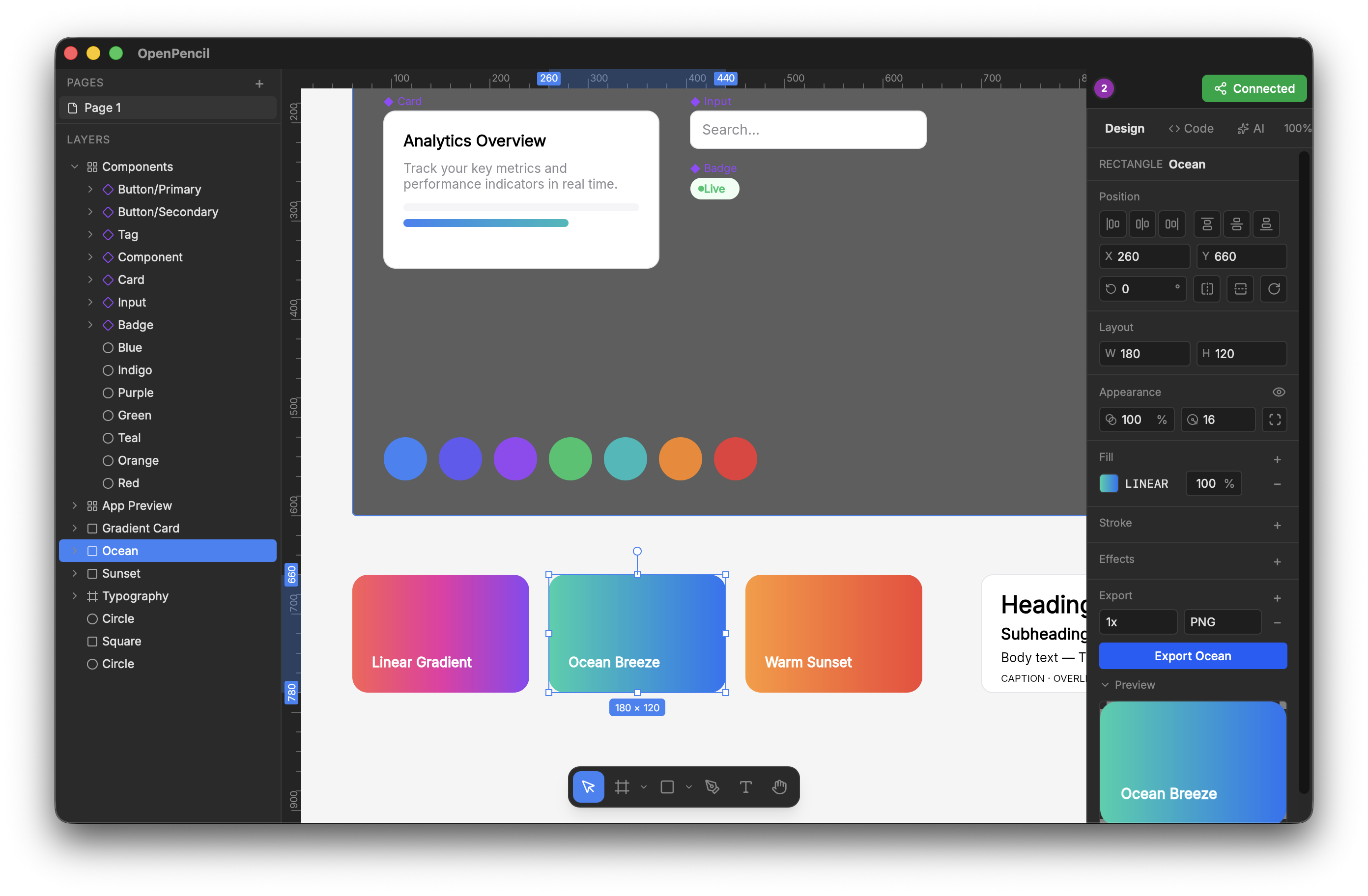
Installation
macOS (Homebrew):
brew install open-pencil/tap/open-pencil
Or download from the releases page, or use the web app — no install needed.
What it does
- Opens .fig files — read and write native Figma files, copy & paste nodes between apps
- AI builds designs — describe what you want in chat, 90 tools create and modify nodes. Bring your own API key
- Fully programmable — headless CLI, Figma Plugin API via
eval, MCP server for AI agents - Real-time collaboration — P2P via WebRTC, no server, no account. Cursors, presence, follow mode
- Tailwind CSS export — export any selection as HTML with Tailwind v4 utility classes
- ~7 MB desktop app — Tauri v2 for macOS, Windows, Linux. Also runs in the browser as a PWA
CLI
bun add -g @open-pencil/cli
Inspect .fig files
Browse node trees, search by name or type, dig into properties — all without opening the editor:
open-pencil tree design.fig
open-pencil find design.fig --type TEXT
open-pencil node design.fig --id 1:23
open-pencil info design.fig
[0] [page] "Getting started" (0:46566)
  [0] [section] "" (0:46567)
    [0] [frame] "Body" (0:46568)
      [0] [frame] "Introduction" (0:46569)
        [0] [frame] "Introduction Card" (0:46570)
          [0] [frame] "Guidance" (0:46571)
Export
Render to PNG, JPG, WEBP, SVG — or export as JSX with Tailwind utility classes:
open-pencil export design.fig                          # PNG
open-pencil export design.fig -f jpg -s 2 -q 90       # JPG at 2x, quality 90
open-pencil export design.fig -f jsx --style tailwind  # Tailwind JSX
<div className="flex flex-col gap-4 p-6 bg-white rounded-xl">
  <p className="text-2xl font-bold text-[#1D1B20]">Card Title</p>
  <p className="text-sm text-[#49454F]">Description text</p>
</div>
Analyze design tokens
Audit an entire design system from the terminal — find inconsistencies, extract the real palette, spot components waiting to be extracted:
open-pencil analyze colors design.fig
open-pencil analyze typography design.fig
open-pencil analyze spacing design.fig
open-pencil analyze clusters design.fig
#1d1b20  ██████████████████████████████ 17155×
#49454f  ██████████████████████████████ 9814×
#ffffff  ██████████████████████████████ 8620×
#6750a4  ██████████████████████████████ 3967×

3771× frame "container" (100% match)
     size: 40×40, structure: Frame > [Frame]

2982× instance "Checkboxes" (100% match)
     size: 48×48, structure: Instance > [Frame]
Script with Figma Plugin API
eval gives you the full Figma Plugin API. Modify the file, write it back:
open-pencil eval design.fig -c "figma.currentPage.children.length"
open-pencil eval design.fig -c "figma.currentPage.selection.forEach(n => n.opacity = 0.5)" -w
Control the running app
When the desktop app is running, omit the file argument — the CLI connects via RPC and operates on the live canvas. Useful for automation scripts, CI pipelines, or AI agents that need to interact with the editor:
open-pencil tree                               # Inspect the live document
open-pencil export -f png                      # Screenshot the current canvas
open-pencil eval -c "figma.currentPage.name"   # Query the editor
All commands support --json for machine-readable output.
AI & MCP
Built-in chat
Press ⌘J to open the AI assistant. It has 87 tools that can create shapes, set fills and strokes, manage auto-layout, work with components and variables, run boolean operations, analyze design tokens, and export assets. Bring your own OpenRouter API key — no backend, no account.
MCP server
Connect Claude Code, Cursor, Windsurf, or any MCP client to read and write .fig files headlessly. 90 tools (87 core + 3 file management). Full docs →
Stdio (Claude Code, Cursor, Windsurf):
bun add -g @open-pencil/mcp
{
  "mcpServers": {
    "open-pencil": {
      "command": "openpencil-mcp"
    }
  }
}
HTTP (scripts, CI):
openpencil-mcp-http # http://localhost:3100/mcp
AI agent skill
Teach your AI coding agent to use OpenPencil — inspect designs, export assets, analyze tokens, modify .fig files:
npx skills add open-pencil/skills@open-pencil
Works with Claude Code, Cursor, Windsurf, Codex, and any agent that supports skills.
Collaboration
Share a link to co-edit in real time. No server, no account — peers connect directly via WebRTC.
- Click the share button in the top-right panel
- Share the generated link (
app.openpencil.dev/share/<room-id>) - Collaborators see your cursor, selection, and edits in real time
- Click a peer's avatar to follow their viewport
Why
Figma is a closed platform that actively fights programmatic access. Their MCP server is read-only. figma-use added full read/write automation via CDP — then Figma 126 killed CDP. Your design files are in a proprietary binary format that only their software can fully read. Your workflows break when they decide to ship a point release.
OpenPencil is the alternative: open source (MIT), reads .fig files natively, every operation is scriptable, and your data never leaves your machine.
Roadmap
- 100% .fig compatibility — full rendering parity with Figma
- Shader effects (SkSL) — custom visual effects via GPU shaders
- Skewing and OkHCL color support
- Raster tile caching — instant zoom/pan for complex documents
- Component libraries — publish, share, and consume design systems
- CI tools — design linting, code export, visual regression in pipelines
- Windows code signing (Azure certificates for properly signed binaries)
- Experimental WebGPU/Graphite rendering backend
Contributing
Setup
bun install
bun run dev        # Dev server at localhost:1420
bun run tauri dev  # Desktop app (requires Rust)
Quality gates
| Command | Description |
|---|---|
bun run check |
Lint + typecheck |
bun run test |
E2E visual regression |
bun run test:unit |
Unit tests |
bun run format |
Code formatting |
Project structure
packages/
  core/           @open-pencil/core — engine (scene graph, renderer, layout, codec)
  cli/            @open-pencil/cli — headless CLI
  mcp/            @open-pencil/mcp — MCP server (stdio + HTTP)
  docs/           Documentation site (openpencil.dev)
src/              Vue app (components, composables, stores)
desktop/          Tauri v2 (Rust + config)
tests/            E2E (188 tests) + unit (764 tests)
Tech stack
| Layer | Tech |
|---|---|
| Rendering | Skia (CanvasKit WASM) |
| Layout | Yoga WASM |
| UI | Vue 3, Reka UI, Tailwind CSS 4 |
| File format | Kiwi binary + Zstd + ZIP |
| Collaboration | Trystero (WebRTC P2P) + Yjs (CRDT) |
| Desktop | Tauri v2 |
| AI/MCP | OpenRouter, @modelcontextprotocol/sdk, Hono |
Desktop builds
Requires Rust and platform-specific prerequisites (Tauri v2 guide).
bun run tauri build
Acknowledgments
Thanks to @sld0Ant (Anton Soldatov) for creating and maintaining the documentation site.
License
MIT