 c60e63c3c6
* Add CShells package references and integrate shell features into the application * Annotate shell features with `[ShellFeature]` attribute and update `TempElsaFeature` to use `ConfigureElsa`. * Revert "Annotate shell features with `[ShellFeature]` attribute and update `TempElsaFeature` to use `ConfigureElsa`." This reverts commit e8a875e8f9d14891c5403df50e8ac7e151db25dd. * Introduce `Elsa.ModularServer.Web` with a minimal API, restructure shell feature configuration, and remove obsolete `CShells` dependency * Update `CShells` package references, add Fody weaver, and configure new CShells package sources in `NuGet.Config`. * Adds CShells integration to Elsa Integrates CShells to enhance modularity and extensibility. - Adds CShells related projects to the solution. - Updates NuGet configuration to include CShells preview feed. - Creates initial app settings for CShells configuration. - Adds CShells.AspNetCore project reference. - Implements CShells extensions in the program file. - Creates shell feature classes in Elsa.Common. - Creates shell feature classes in Elsa.Expressions. - Creates shell feature classes in Elsa.Workflows.Core. - Creates shell feature classes in Elsa.Workflows.Management. - Creates shell feature classes in Elsa.Workflows.Runtime. - Creates shell feature classes in Elsa module. * Refactor CShells: enhance pipeline configuration and features Consolidated updates to CShells including a new `ResolverPipelineBuilder` for customizable resolver strategy pipelines. Improved assembly scanning, error handling in web routing, and streamlined shell feature dependencies for better clarity and functionality. * Add feature registration system and FastEndpoints integration Introduced a feature registration infrastructure with `IInstalledFeatureProvider` and related implementations. Added shell-based feature configurations such as caching, SAS tokens, workflows management, and a FastEndpoints integration module to support dynamic API registration. * Refactor shell routing and enhance global route handling Refactored `ShellEndpointRouteBuilder` to simplify initialization and support a combined shell/global route prefix. Enhanced `ShellEndpointRegistrationHandler` to include global route prefix logic and improved feature discovery using pre-resolved descriptors. Updated `Program.cs` for consistent middleware setup. * Refactor feature endpoints to use `IInstalledFeatureProvider` for improved dependency management and simplified implementation * Add display names, descriptions, and dependency enhancements to shell features Standardized `ShellFeature` attributes across `ElsaFeature`, `WorkflowRuntimeFeature`, and `WorkflowManagementFeature` by adding display names, descriptions, and improving dependency declarations. Updated `ElsaFeature` to register `IInstalledFeatureProvider` for feature bridging. * Add FastEndpoints references and update package versions Added project references to CShells.FastEndpoints and related projects in multiple csproj files. Updated FastEndpoints package versions in `Directory.Packages.props` for compatibility with .NET 8/9/10. Removed obsolete folder references from Elsa.Caching.csproj and refined the namespace in CShells.AspNetCore.Abstractions. * Add Identity and DefaultAuthentication features to appsettings.json configuration * Add project references for Elsa.Identity and CShells.FastEndpoints.Abstractions * Add `Identity` and `DefaultAuthentication` shell features with enhanced authentication and authorization support * Set default signing key in `IdentityTokenOptions` for identity configuration * Add service exclusion infrastructure for shell-specific contexts Introduce `IShellServiceExclusionProvider` and `IShellServiceExclusionRegistry` to manage excluded service types per-shell. Implement ASP.NET Core-specific providers for authentication and authorization to enable shell-specific configurations. Refactor `DefaultShellHost` to use the new exclusion registry for service inheritance filtering. * Refactor CShells authentication and authorization APIs Renamed and unified methods for shell authentication and authorization and added a new combined method `WithAuthenticationAndAuthorization`. Enhanced `AddShells` to automatically register a default configuration provider if none is specified. Updated usage in Elsa.ModularServer to utilize the new API. * Add Elsa-specific FastEndpoints configurator and feature Introduce `ElsaFastEndpointsConfigurator` to customize FastEndpoints serialization and value parsing for Elsa workflows. Register this functionality through the new `ElsaFastEndpointsFeature`, which integrates with the shell's dependency injection system using an `IFastEndpointsConfigurator` interface. * Update Workflow API feature dependency to `ElsaFastEndpoints` * Pass `cancellationToken` to `ReadToEndAsync` in `PostEndpoint` for improved request handling. * Add project references for CShells.AspNetCore and CShells.FastEndpoints.Abstractions * Update CShells package versions to `0.0.6-preview.30` and add `CShells.FastEndpoints.Abstractions` * Configures shell routing and features Enables path routing for shells to allow proper routing within each shell. Configures the ElsaFastEndpoints feature to depend on the FastEndpoints feature. This ensures that FastEndpoints is properly configured before Elsa's FastEndpoints configurations are applied. Registers activity types within the WorkflowManagementFeature. This ensures activities are available for workflow construction and execution. * Add shell lifecycle management and notification handlers Introduced interfaces and handlers for shell activation (`IShellActivatedHandler`) and deactivation (`IShellDeactivatingHandler`) to manage shell lifecycles. Added `ShellStartupHostedService` to coordinate shell activation on startup and deactivation on shutdown. Updated notification system to support new shell lifecycle events and renamed existing notification records for consistency. * Introduces EF Core persistence layer Adds base classes and implementations for EF Core persistence, including database provider configuration and shell feature integration. This change introduces a generic approach to configuring EF Core persistence for various Elsa modules, promoting code reuse and simplifying the process of supporting different database providers. It includes: - Base classes for database provider configurators and shell features. - Implementations for Sqlite, SQL Server, MySql, PostgreSql, and Oracle. - Shell features for Alterations, Identity, Labels, Management (Workflow Definitions and Instances), Runtime, and Tenants modules. * Add comprehensive feature configuration validation system Introduce a feature configuration system with support for binding, auto-configuration, and validation using DataAnnotations, FluentValidation, and composite patterns. Includes new validators, binding logic, and extensions to simplify configuration tasks while ensuring robustness and flexibility. * Add persistence shell features for MySql, Oracle, PostgreSql, and Sqlite Introduced new shell features to configure MySql, Oracle, PostgreSql, and Sqlite persistence for workflow definitions and runtime data. Updated `appsettings.json` to replace individual Sqlite features with a unified `SqliteWorkflowPersistence`. Made minor code cleanup in `FastEndpointsFeature`. * Configure shell features for persistence Added `IServiceCollection` configuration for MySql, Oracle, PostgreSql, and Sqlite shell features to set up persistence services. * Remove DatabaseProviderConfigurators and refactor persistence shell features Deleted DatabaseProviderConfigurator classes and restructured persistence shell features by integrating direct configuration logic for MySql, Oracle, PostgreSql, Sqlite, and SqlServer. Simplified configuration by inheriting from abstract shell feature base classes and removed redundant code. * Correct IWorkflowDefinitionPublisher registration to use WorkflowDefinitionPublisher implementation * Add resilience feature and scoped services configuration for Sqlite persistence - Integrated `Microsoft.Extensions.DependencyInjection` to shell features for Sqlite persistence. - Updated `appsettings.json` and project references to include a new 'Resilience' feature. - Changed `ICommitStateHandler` service registration in `WorkflowRuntimeFeature` to use an implementation. * Add `ResilienceShellFeature` for configuring resilience strategies - Implemented new `ResilienceShellFeature` class to manage services related to resilience features. - Added scoped and singleton service registrations for resilience strategies, exception detection, and activity invocation. - Configured expression options for resilience handling in workflows. * Add new shell features: Alterations, Blob Storage, Caching, Clustering, CSharp, Distributed Runtime, ElsaScript, Flowchart, HTTP, JavaScript, Key-Value, and Labels * Switch project references to package references for CShells libraries and update to version 0.0.7. * Potential fix for pull request finding 'Call to 'System.IO.Path.Combine' may silently drop its earlier arguments' Co-authored-by: Copilot Autofix powered by AI <223894421+github-code-quality[bot]@users.noreply.github.com> * Fix shell feature discovery and remove duplicate service registrations (#7285) * Initial plan * Address PR review comments: Add ShellFeature attributes, fix duplicates, and improve security Co-authored-by: sfmskywalker <938393+sfmskywalker@users.noreply.github.com> --------- Co-authored-by: copilot-swe-agent[bot] <198982749+Copilot@users.noreply.github.com> Co-authored-by: sfmskywalker <938393+sfmskywalker@users.noreply.github.com> * Update dependencies and fix scoped services registration in `WorkflowRuntimeFeature` * Fix null reference and typo in shell feature provider (#7286) * Initial plan * Fix null StartupType guard in Find() and typo in variable descriptor Co-authored-by: sfmskywalker <938393+sfmskywalker@users.noreply.github.com> --------- Co-authored-by: copilot-swe-agent[bot] <198982749+Copilot@users.noreply.github.com> Co-authored-by: sfmskywalker <938393+sfmskywalker@users.noreply.github.com> --------- Co-authored-by: Copilot Autofix powered by AI <223894421+github-code-quality[bot]@users.noreply.github.com> Co-authored-by: Copilot <198982749+Copilot@users.noreply.github.com> Co-authored-by: sfmskywalker <938393+sfmskywalker@users.noreply.github.com> |
||
|---|---|---|
| .config | ||
| .github | ||
| .nuke | ||
| build | ||
| design | ||
| doc | ||
| docker | ||
| gen | ||
| scripts | ||
| src | ||
| test | ||
| .editorconfig | ||
| .gitignore | ||
| build.cmd | ||
| build.ps1 | ||
| build.sh | ||
| CONTRIBUTING.md | ||
| Directory.Build.props | ||
| Directory.Packages.props | ||
| dotnet-install.sh | ||
| Elsa.sln | ||
| Elsa.sln.DotSettings | ||
| icon.png | ||
| LICENSE | ||
| NuGet.Config | ||
| README.md | ||
| run-dsl-tests.sh | ||
| test-flowchart.txt | ||
| test-simple-flowchart.elsa | ||

Elsa Workflows









For Elsa 2, Click Here
Introduction
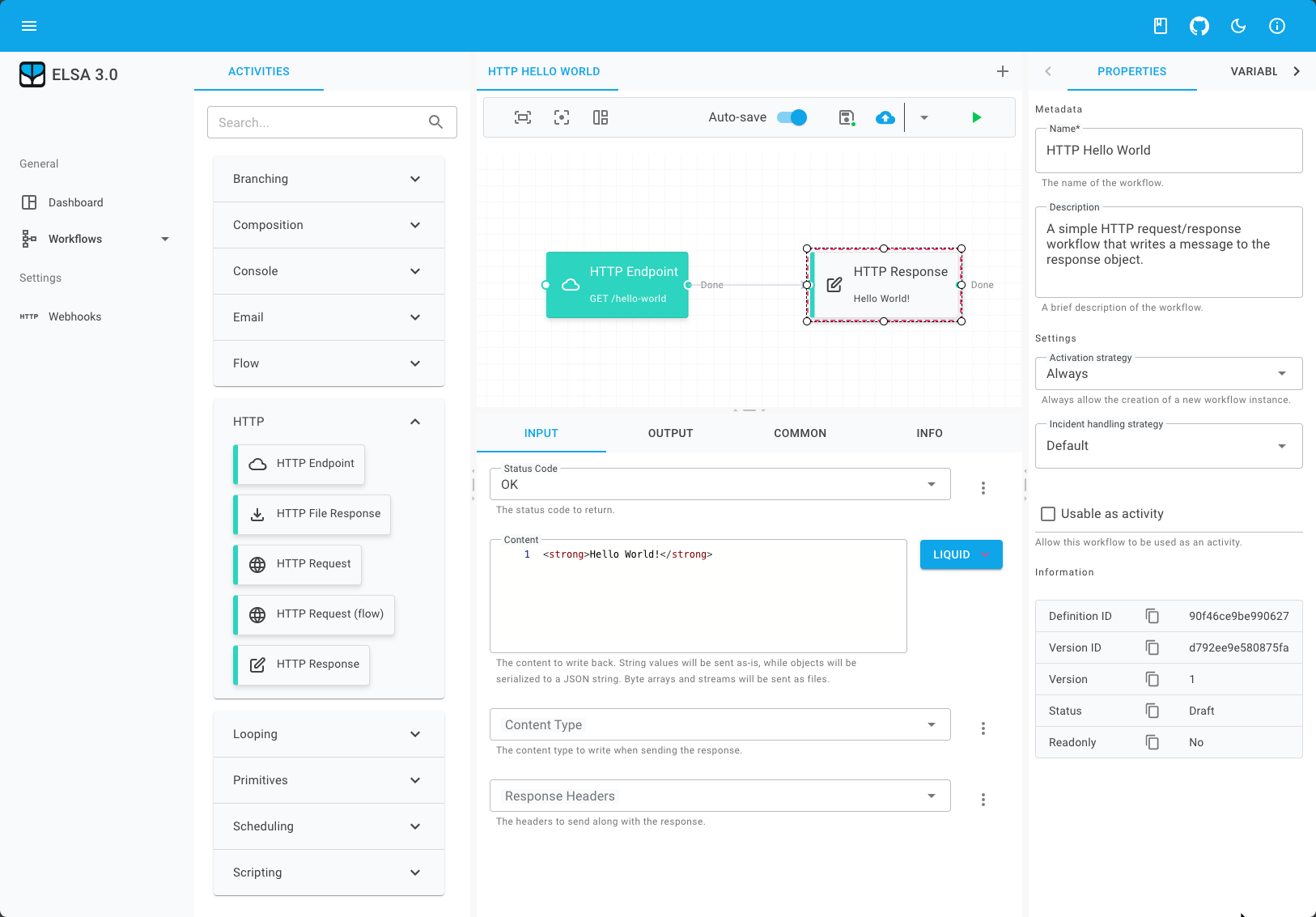
Elsa is a powerful workflow library that enables workflow execution within any .NET application. Elsa allows you to define workflows in various ways, including:
- Writing C# code
- Using a visual designer
- Specifying workflows in JSON
Try with Docker
To give the Elsa Studio + Elsa Server a quick spin, you can run the following command to start the Elsa Docker container:
docker pull elsaworkflows/elsa-server-and-studio-v3:latest
docker run -t -i -e ASPNETCORE_ENVIRONMENT='Development' -e HTTP_PORTS=8080 -e HTTP__BASEURL=http://localhost:13000 -p 13000:8080 elsaworkflows/elsa-server-and-studio-v3:latest
This Docker image is based on a reference ASP.NET application that hosts both the workflow server and designer and is not intended for production use.
By default, you can access http://localhost:13000 and log in with:
  Username: admin
  Password: password
TLS and custom certificate authorities
All Elsa Docker images now ship with the operating system's certificate authority bundle baked in at build time. This means you can call public HTTPS endpoints such as https://example.com without any additional configuration.
If you need to trust a private or corporate CA, mount the certificate bundle into the container and reference it via EXTRA_CA_CERT:
docker run \
  -v /path/to/company-ca.crt:/certs/company-ca.crt:ro \
  -e EXTRA_CA_CERT=/certs/company-ca.crt \
  elsaworkflows/elsa-server-and-studio-v3:latest
On startup, the container copies the certificate into /usr/local/share/ca-certificates and runs update-ca-certificates, making the trust available to .NET, OpenSSL, curl, and other system components. Multiple certificates can be provided by pointing EXTRA_CA_CERT at a directory containing .crt or .pem files.
In highly restricted environments where you cannot modify the system trust store, you can instead rely on the standard SSL_CERT_FILE or SSL_CERT_DIR environment variables:
docker run \
  -v /path/to/company-ca-bundle.pem:/certs/custom.pem:ro \
  -e SSL_CERT_FILE=/certs/custom.pem \
  elsaworkflows/elsa-server-and-studio-v3:latest
ℹ️ Installing the CA bundle adds roughly 300KB to the Debian-based images. No package managers run at container startup; all trust updates happen immutably at build time or via the mounted certificates shown above.
Table of Contents
- Documentation
- Known Issues and Limitations
- Features
- Roadmap
- Use Cases
- Coding Workflows
- Designed Workflows
- Contributing
- Support
Documentation
Known Issues and Limitations
Elsa is continually evolving, and while it offers powerful capabilities, there are some known limitations and ongoing work:
- Documentation is still a work in progress.
- Input/Output is not yet implemented in the Workflow Instance Viewer.
- Starting workflows from the designer is currently supported only for workflows that do not require input and do not start with a trigger; this is planned for a future release.
- The designer currently only supports Flowchart activities. Support for Sequence and StateMachine activities is planned for a future release.
- UI input validation is not yet implemented.
Features
Elsa offers a wide range of features for building and executing workflows, including:
- Execution of workflows in any .NET application with support for .NET 6 and beyond.
- Support for both short-running and long-running workflows.
- A programming model loosely inspired by Windows Workflow Foundation.
- A web-based drag & drop designer with support for custom activities.
- Native support for activity composition, including activities like
Sequence,Flowchart, andForEach. - Parallel execution of activities.
- Built-in activities for common scenarios, such as sending emails, making HTTP calls, scheduling tasks, sending and receiving messages, and more.
- Workflow versioning and migration via API.
- Easy integration with external applications via HTTP, message queues, and more.
- Actor model for increased workflow throughput.
- Dynamic expressions with support for C#, JavaScript, Python, and Liquid.
- Persistence agnostic, with support for Entity Framework Core, MongoDB, and Dapper out of the box.
- Elsa Studio: a modular Blazor dashboard app for managing and designing workflows.
Roadmap
See #3232
Use Cases
Elsa can be used in a variety of scenarios, including:
- Long-running workflows such as order fulfillment and product approval.
- Short-running workflows such as sending emails and generating PDFs.
- Scheduled workflows such as sending daily reports.
- Event-driven workflows such as sending welcome emails when a user signs up.
Coding Workflows
Elsa allows you to define workflows in code using C#. The following example shows how to receive HTTP requests and send an email in response:
public class SendEmailWorkflow : WorkflowBase
{
    protected override void Build(IWorkflowBuilder builder)
    {
        builder.Root = new Sequence
        {
            Activities =
            {
                new HttpEndpoint
                {
                    Path = new("/send-email"),
                    SupportedMethods = new(new[] { HttpMethods.Post }),
                    CanStartWorkflow = true
                },
                new SendEmail
                {
                    From = new("alic@acme.com"),
                    To = new(new[]{ "bob@acme.com" }),
                    Subject = new("Your workflow has been triggered!"),
                    Body = new("Hello!")
                }
            }
        };
    }
}
Designing Workflows
Elsa allows you to define workflows using a visual designer. The following example shows how to receive HTTP requests and send an email in response:

Contributing
We welcome contributions from the community and are pleased that you are interested in helping to improve the Elsa Workflow project! Here are the steps to contribute to our project:
1. Fork and Clone the Repo
To get started, you'll need to fork the repository to your own GitHub account. You can do this by navigating to the Elsa Workflow GitHub repository and clicking the "Fork" button in the top-right corner of the page. Once you have forked the repo, you can clone it to your local machine using the following command:
git clone https://github.com/YOUR_USERNAME/elsa-core.git
Replace YOUR_USERNAME with your GitHub username. For more information on forking a repo, check out the GitHub documentation here.
Incorporating the details about the "apps" folder and its projects into the second point about opening the Elsa.sln using your favorite IDE, we can expand the instructions to guide developers on where to start and what projects they might want to explore first. Here's an updated version of that section with the additional information:
2. Open Elsa.sln Using Your Favorite IDE
After cloning the repository, navigate to the cloned directory and open the Elsa.sln solution file with your preferred IDE that supports .NET development, such as Visual Studio, JetBrains Rider, or Visual Studio Code with the appropriate extensions.
Within the solution, you will find an "apps" folder containing three projects designed to help you get started and explore the capabilities of Elsa Workflow:
-
Elsa.Server.Web: This project is a reference ASP.NET Core application that acts as a workflow server. It's a great starting point if you want to understand how Elsa functions as a server-side workflow engine.
-
Elsa.ServerAndStudio.Web: This project serves a dual purpose. Like
Elsa.Server.Web, it acts as a workflow server. Additionally, it hosts the Elsa Studio Blazor WebAssembly app. This is the perfect project to run if you want to see the full capabilities of Elsa, including both the server aspects and the client-side studio experience in one application. -
Elsa.Studio.Web: This project is a reference Blazor WebAssembly application that solely hosts the Elsa Studio Blazor WebAssembly app. It requires a running Elsa server application to connect to. Use this project if you're interested in focusing on the Elsa Studio UI and its interactions with an Elsa workflow server.
3. Submit a PR with Your Changes
Once you have made your changes, commit them and push them back to your fork. Then, navigate to the original Elsa Workflow repository and create a new Pull Request. Ensure your PR description clearly describes the changes and any relevant information that will help the reviewers understand your contributions. For a detailed guide on creating a pull request, visit Creating a pull request from a fork.
4. Open an Issue First
Before you start working on your changes or submit a pull request, please open an issue to discuss what you would like to do. This step is crucial as it ensures you don't spend time working on something that might not align with the project's goals or might already be under development by someone else. You can open an issue here.
This approach helps us streamline contributions and ensures that your efforts are aligned with the project's needs and priorities. We look forward to your contributions and are here to support you throughout the process. Thank you for contributing to the Elsa Workflow project!
Support
There are various ways to get support for Elsa Workflows, ranging from community-driven channels to enterprise-level services.
Community Support
Elsa has an active and helpful community where you can find support through multiple channels:
- GitHub Issues for bug reports and feature requests.
- GitHub Discussions for open-ended conversations, questions, and community-driven support.
- Discord for real-time support and interaction with the Elsa community.
- StackOverflow for searching or asking technical questions.
Professional Support
For organizations requiring professional support and long-term commitment, check out Elsa+, a growing ecosystem of premium services, tooling, and extensions around Elsa Workflows.