 b6689c7e2b
* Refactor hash method in Hasher.cs The Hash method in the Hasher.cs file has been refactored to use more efficient code. Instead of creating a SHA256 instance, it directly hashes the data using SHA256.HashData. As a result, the private Hash method and its usage, which only has relevance to the previous approach, have been removed. * Replace GetHashCode with SHA256 for script caching Two unused namespaces, Esprima and Esprima.Ast, have been removed, and two new ones, System.Security.Cryptography and System.Text, have been added. These changes in Elsa.JavaScript's JintJavaScriptEvaluator file were made to replace the basic GetHashCode method, which was used earlier to generate a cache key for JavaScript scripts, with SHA256 hash function to ensure uniqueness and avoid possible hash collisions. This greatly increases the reliability of the caching mechanism. * Set HTTP client timeout in WorkflowServer The client timeout in WorkflowServer has been set to 1 minute for `ResrService` and `client` methods. This was done to manage long running requests and prevent timeouts. * Refactor code and add validation in ScheduleActivityAsync methods An unnecessary line of code in the ScheduleActivityAsync method under the ActivityExecutionContext file has been removed to simplify the function. Meanwhile, validation has been added to ensure that specified activities are part of the workflow. This improves code clarity and prevents potential errors caused by incorrect activity scheduling. * Refactor ActivityVisitor to use ActivityVisitorContext The ActivityVisitor class in Elsa.Workflows.Core was refactored to use an ActivityVisitorContext class. The introduction of this context class replaced the multiple hashsets that were used within function signatures, consolidating them into a single object and reducing function complexity. This change improves readability and code organization. * Refactor WorkflowDefinitionActivity to use WorkflowGraph Adjusted the WorkflowDefinitionActivity class in the Elsa.Workflows.Management module. The changes include migration from using Workflow to WorkflowGraph objects and condensing code blocks for clearer readability. Additionally, a new 'IsInitialized' field is added to eliminate potential race conditions during the graph construction process. * Add activity validation to WorkflowExecutionContext A check has been implemented in the WorkflowExecutionContextExtensions to validate that a specified activity is part of the workflow. This prevents incorrect activity references when scheduling tasks in the workflow. * Refactor to use WorkflowGraph instead of Workflow The codebase has been refactored to utilize the WorkflowGraph instead of the Workflow while running and manipulating workflows. Additional changes include restructuring WorkflowRunner and WorkflowDefinitionService classes, introducing WorkflowGraphBuilder usage, and mapping updates in WorkflowDefinitionMapper. The WorkflowHost, WorkflowDispatcher, and WorkflowExecutionContext have also been updated accordingly. * Add WorkflowGraph and related services This commit introduces the IWorkflowGraphBuilder interface, the WorkflowGraph model, and an implementation of the interface in the WorkflowGraphBuilder class. The purpose of these additions is to establish the building and structure of a workflow graph. The WorkflowGraph model also includes activity node handling and hashing capabilities. * Add tests to ensure exception when scheduling an activity not part of workflow Several unit tests were written to ensure that the right behavior is exhibited when scheduling an activity that is not part of the workflow. An exception is expected to be thrown in this case. Additionally, new service definitions, workflow definitions and workflow queries were added for more comprehensive testing. * Update WorkflowGraph class and add comment descriptions This commit updates the WorkflowGraph class by extending its descriptions and implementing an explicit mention to the Workflow reference. Additionally, more attribute descriptions have been added to increase code readability and comprehension. * Removed unnecessary brackets * Remove unused services from workflow management This commit deletes "ExpressionDescriptorRegistryPopulator.cs" and "ScopedWorkflowDefinitionLookup.cs" files from Elsa.Workflows.Management.Services. These files, containing obsolete services, are no longer used in the workflow management process. The services' registration has been removed as well from "WorkflowManagementFeature.cs". * Remove TestWorkflowDefinitionService.cs from component tests A file, TestWorkflowDefinitionService.cs, was removed under Elsa.Workflows.ComponentTests. This is part of the improvement process where inefficient or unnecessary test files are cleaned up. * Add comments to WorkflowDefinitionActivityTests This commit adds explanatory comments to the WorkflowDefinitionActivityTests file. The comments provide information about the purpose of these tests and a reference to a related issue in the project's Github repository. * Updated duplicate and missing package references --------- Co-authored-by: Raymond den Haan <raymond.den.haan@nexxbiz.io> |
||
|---|---|---|
| .github | ||
| .nuke | ||
| build | ||
| design | ||
| docker | ||
| docs | ||
| gen | ||
| migrations | ||
| samples | ||
| src | ||
| test | ||
| .editorconfig | ||
| .gitignore | ||
| build-and-run-all-in-one-web-docker.sh | ||
| build.cmd | ||
| build.ps1 | ||
| build.sh | ||
| CONTRIBUTING.md | ||
| Directory.Build.props | ||
| Directory.Packages.props | ||
| docker-compose.yml | ||
| docker-run-all-in-one-web.ps1 | ||
| Elsa.sln | ||
| Elsa.sln.DotSettings | ||
| generate-migrations-initial copy.sh | ||
| icon.png | ||
| LICENSE | ||
| NuGet.Config | ||
| README.md | ||

ELSA 3.0






For Elsa 2 Click Here
Introduction
Elsa is a powerful workflow library that enables workflow execution within any .NET application. Elsa allows you to define workflows in various ways, including:
- Writing C# code
- Using a visual designer
- Specifying workflows in JSON
Try with Docker
To give the Elsa Studio + Elsa Server a quick spin, you can run the following command to start the Elsa Docker container:
docker pull elsaworkflows/elsa-server-and-studio-v3:latest
docker run -t -i -e ASPNETCORE_ENVIRONMENT='Development' -e HTTP_PORTS=8080 -e HTTP__BASEURL=http://localhost:13000 -p 13000:8080 elsaworkflows/elsa-server-and-studio-v3:latest
This Docker image is based on a reference ASP.NET application that hosts both the workflow server and designer and is not intended for production use.
By default, you can access http://localhost:13000 and log in with:
  Username: admin
  Password: password
Table of Contents
Documentation
For comprehensive documentation and to get started with Elsa, please visit the Elsa Documentation Website.
Known Issues and Limitations
Elsa is continually evolving, and while it offers powerful capabilities, there are some known limitations and ongoing work:
- Documentation is still a work in progress.
- The designer is not yet fully embeddable in other applications; this feature is planned for a future release.
- C# and Python expressions are not yet fully tested.
- Bulk Dispatch Workflows is a new activity and not yet fully tested.
- Input/Output is not yet implemented in the Workflow Instance Viewer.
- Starting workflows from the designer is currently supported only for workflows that do not require input and do not start with a trigger; this is planned for a future release.
- The designer currently only supports Flowchart activities. Support for Sequence and StateMachine activities is planned for a future release.
- UI input validation is not yet implemented.
Features
Elsa offers a wide range of features for building and executing workflows, including:
- Execution of workflows in any .NET application with support for .NET 6 and beyond.
- Support for both short-running and long-running workflows.
- A programming model loosely inspired by Windows Workflow Foundation.
- A web-based drag & drop designer with support for custom activities.
- Native support for activity composition, including activities like
Sequence,Flowchart, andForEach. - Parallel execution of activities.
- Built-in activities for common scenarios, such as sending emails, making HTTP calls, scheduling tasks, sending and receiving messages, and more.
- Workflow versioning and migration via API.
- Easy integration with external applications via HTTP, message queues, and more.
- Actor model for increased workflow throughput.
- Dynamic expressions with support for C#, JavaScript, Python, and Liquid.
- Persistence agnostic, with support for Entity Framework Core, MongoDB, and Dapper out of the box.
- Elsa Studio: a modular Blazor dashboard app for managing and designing workflows.
Roadmap
The following features are planned for future releases of Elsa:
- Multi-tenancy
- State Machine activity
- Designer support for Sequence activity & StateMachine activity
- BPMN 2.0 support
- DMN support
- Workflow migration to new versions via UI
- Capsules ("hot" deployable workflow packages containing activities and configuration)
Use Cases
Elsa can be used in a variety of scenarios, including:
- Long-running workflows such as order fulfillment and product approval.
- Short-running workflows such as sending emails and generating PDFs.
- Scheduled workflows such as sending daily reports.
- Event-driven workflows such as sending welcome emails when a user signs up.
Programmatic Workflows
Elsa allows you to define workflows in code using C#. The following example shows how to receive HTTP requests and send an email in response:
public class SendEmailWorkflow : WorkflowBase
{
    protected override void Build(IWorkflowBuilder builder)
    {
        builder.Root = new Sequence
        {
            Activities =
            {
                new HttpEndpoint
                {
                    Path = new("/send-email"),
                    SupportedMethods = new(new[] { HttpMethods.Post }),
                    CanStartWorkflow = true
                },
                new SendEmail
                {
                    From = new("alic@acme.com"),
                    To = new(new[]{ "bob@acme.com" }),
                    Subject = new("Your workflow has been triggered!"),
                    Body = new("Hello!")
                }
            }
        };
    }
}
Designed Workflows
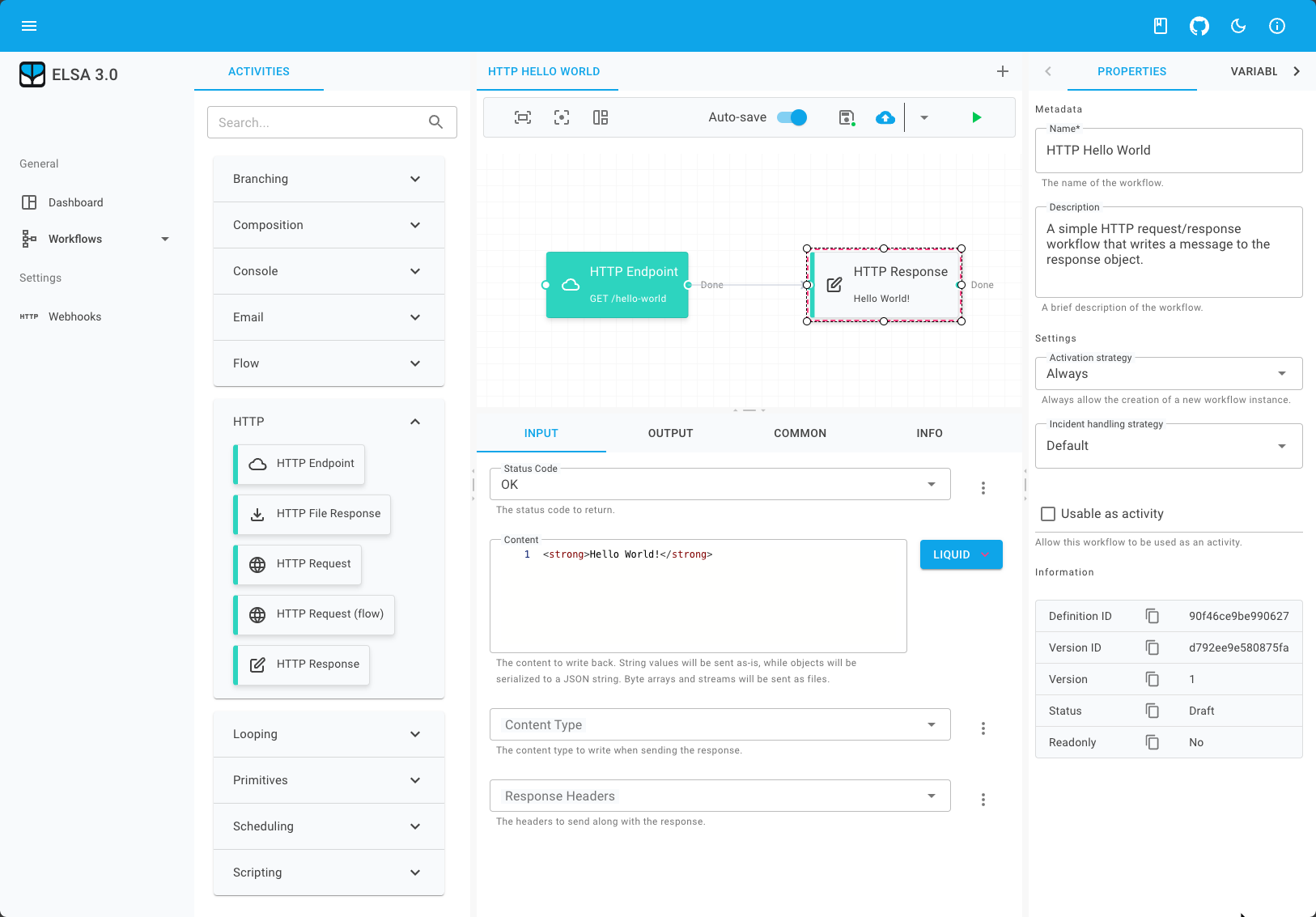
Elsa allows you to define workflows using a visual designer. The following example shows how to receive HTTP requests and send an email in response:

Contributing
We welcome contributions from the community and are pleased that you are interested in helping to improve the Elsa Workflow project! Here are the steps to contribute to our project:
1. Fork and Clone the Repo
To get started, you'll need to fork the repository to your own GitHub account. You can do this by navigating to the Elsa Workflow GitHub repository and clicking the "Fork" button in the top-right corner of the page. Once you have forked the repo, you can clone it to your local machine using the following command:
git clone https://github.com/YOUR_USERNAME/elsa-core.git
Replace YOUR_USERNAME with your GitHub username. For more information on forking a repo, check out the GitHub documentation here.
Incorporating the details about the "bundles" folder and its projects into the second point about opening the Elsa.sln using your favorite IDE, we can expand the instructions to guide developers on where to start and what projects they might want to explore first. Here's an updated version of that section with the additional information:
2. Open Elsa.sln Using Your Favorite IDE
After cloning the repository, navigate to the cloned directory and open the Elsa.sln solution file with your preferred IDE that supports .NET development, such as Visual Studio, JetBrains Rider, or Visual Studio Code with the appropriate extensions.
Within the solution, you will find a "bundles" folder containing three projects designed to help you get started and explore the capabilities of Elsa Workflow:
-
Elsa.Server.Web: This project is a reference ASP.NET Core application that acts as a workflow server. It's a great starting point if you want to understand how Elsa functions as a server-side workflow engine.
-
Elsa.ServerAndStudio.Web: This project serves a dual purpose. Like
Elsa.Server.Web, it acts as a workflow server. Additionally, it hosts the Elsa Studio Blazor WebAssembly app. This is the perfect project to run if you want to see the full capabilities of Elsa, including both the server aspects and the client-side studio experience in one application. -
Elsa.Studio.Web: This project is a reference Blazor WebAssembly application that solely hosts the Elsa Studio Blazor WebAssembly app. It requires a running Elsa server application to connect to. Use this project if you're interested in focusing on the Elsa Studio UI and its interactions with an Elsa workflow server.
3. Submit a PR with Your Changes
Once you have made your changes, commit them and push them back to your fork. Then, navigate to the original Elsa Workflow repository and create a new Pull Request. Ensure your PR description clearly describes the changes and any relevant information that will help the reviewers understand your contributions. For a detailed guide on creating a pull request, visit Creating a pull request from a fork.
4. Open an Issue First
Before you start working on your changes or submit a pull request, please open an issue to discuss what you would like to do. This step is crucial as it ensures you don't spend time working on something that might not align with the project's goals or might already be under development by someone else. You can open an issue here.
This approach helps us streamline contributions and ensures that your efforts are aligned with the project's needs and priorities. We look forward to your contributions and are here to support you throughout the process. Thank you for contributing to the Elsa Workflow project!
Remember to replace any placeholder URLs or instructions with the specific details relevant to the Elsa Workflow project as necessary.